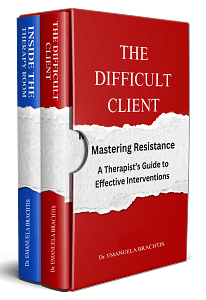
When the session stalls… what do you do next?
Dr. Emanuela Brachtis
Clinical Psychologist | 17+ Years in Complex Practice
For 17 years, I’ve worked with anxiety, trauma, emotional dysregulation, and high-conflict dynamics—using an integrative blend of CBT, DBT, and psychodynamic principles. But what matters most isn’t the model—it’s what you do in the room when theory meets uncertainty.
These books emerged from one question I kept hearing from colleagues: “What would you actually say or do in session when the client shuts down, escalates, or won’t engage?” This is my answer—grounded in real cases, not idealized scenarios.
Inside the Therapy Room
30 Real Cases & Techniques That Work
A Therapist’s Guide to Effective Interventions
What actually happens when theory meets a resistant client, a dissociative pause, or a ruptured alliance? This book shows you—through 30 unvarnished case studies drawn from real sessions.
No idealized scripts. Just moment-by-moment decisions, repairs, and turning points—paired with strategies you can adapt to your own style and modality.
- Anxiety & Panic: Exposure sequencing that respects somatic thresholds
- Depression: Behavioral activation that works—even when motivation is absent
- Trauma & PTSD: EMDR and IFS integrated with pacing and grounding
- Couples: Repairing contempt through micro-attunements, not grand gestures
- Personality Dynamics: DBT and schema strategies for high-conflict patterns
- Burnout & Grief: Supporting clients—and yourself—through identity shifts
140 Pages | Clinician-Designed | Practice-Ready
See What Therapists Are Saying
These resources were designed in clinical practice, for clinical practice. Below, colleagues share how the books have supported their work with complex cases, resistant dynamics, and therapeutic impasses.
The Difficult Client
Mastering Resistance, High-Conflict, and Stuck Cases in Therapy
Resistance isn’t defiance. Stagnation isn’t failure. They’re signals—often the first clues to what the client truly needs.
Drawing on 17 years of clinical work, this guide helps you respond with clarity, not frustration—using real case illustrations to show how to:
- Reframe resistance as relational communication—and respond without rupture
- De-escalate high-conflict dynamics while holding firm, compassionate boundaries
- Reignite stalled processes through attuned pacing, not pressure
For clinicians who believe even the “most difficult” client is offering an invitation—to listen more deeply, intervene more wisely, and stay grounded in your own practice.
Join
Whether you’re navigating your first complex case or your hundredth, these guides offer clinically grounded strategies—rooted in real sessions, not just theory—to sharpen your judgment, deepen the alliance, and restore your confidence when the work gets tough.
Special Offer
$29.90
Originally $39.50
Get both The Difficult Client and Inside the Therapy Room—two practice-tested guides for therapists who want to move beyond theory and respond with clarity in their most challenging sessions.
Get the BundleInstant digital access • Secure checkout

Frequency Asked Question
These books are designed for licensed psychotherapists, clinical psychologists, counselors, and trainees who want to deepen their clinical effectiveness. They are especially valuable for clinicians working with anxiety, trauma, personality dynamics, and treatment-resistant cases. The content bridges theory and real-world practice, offering tools you can apply immediately.
Yes. Both The Difficult Client and Inside the Therapy Room are grounded in empirically supported modalities, including Cognitive Behavioral Therapy (CBT), Dialectical Behavior Therapy (DBT), EMDR, Internal Family Systems (IFS), and attachment-informed interventions. Each technique is contextualized within actual clinical scenarios to enhance applicability.
Not at all. While the books address high-conflict and stuck cases, they are structured to support clinicians at various levels of experience. Early-career therapists will gain clarity on managing resistance and emotional intensity, while seasoned practitioners will find nuanced strategies for refining their approach.
Unlike dense theoretical texts, these books focus on what actually happens in session. Through 30 real-world case studies and direct intervention breakdowns, you’ll see how strategies unfold in real time — including missteps, repairs, and turning points. This practice-first approach helps translate knowledge into skill.
Absolutely. These resources are ideal for clinical supervision, team trainings, and postgraduate education. The case studies provide excellent discussion prompts, and the structured interventions support skill-building in areas like alliance repair, de-escalation, and pacing therapeutic change.
Yes. While the books draw from cognitive-behavioral and systems-based models, the principles — such as therapeutic presence, alliance-building, and emotional regulation — are trans-theoretical. Clinicians from psychodynamic, humanistic, or integrative backgrounds will find adaptable insights that align with their framework.
At this time, the books do not offer formal continuing education (CE) credits. However, they are excellent resources for self-directed professional development and can be used toward independent study hours in many licensing jurisdictions. Always check with your regulatory body for specific requirements.
Your satisfaction matters. If the books don’t meet your expectations, please contact us within 14 days of purchase for a full refund. We’re confident these resources will become trusted companions in your clinical practice.