Description
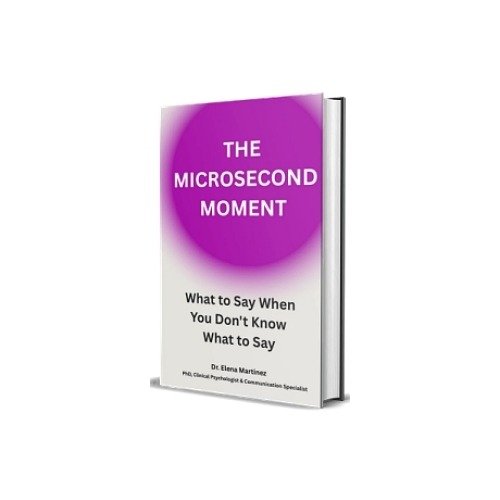
The Microsecond Moment
What to Say When You Don’t Know What to Say
Why This Book?
In the quiet corners of nearly every therapy room, there is a moment that’s rarely talked about in training, textbooks, or supervision — a moment of internal disorientation. A client says something unexpected, breaks into tears, goes completely silent, or asks a loaded question. And suddenly, your carefully planned session outline evaporates. Your thoughts scatter, and for just a second — maybe two — you don’t know what to say.
Every clinician knows this moment. It doesn’t matter whether you’re a newly licensed therapist or someone with thirty years of experience. These brief, high-pressure seconds happen to all of us. And while they often pass unnoticed on the surface, they carry immense weight beneath it. They are moments filled with uncertainty, vulnerability, potential rupture… and paradoxically, opportunity.
This book is for those moments.
Unlike textbooks that teach structured interventions or manuals that provide step-by-step protocols, The Microsecond Moment focuses on what happens in the unscripted spaces of a session. It gives language to the internal experience of being a therapist in real time — to the pause between hearing and responding, the stutter between presence and performance, the silence that hangs while your mind races.
More importantly, this book offers practical tools — phrases, frameworks, and mindset shifts — that can help you respond from a place of grounded clarity instead of panic or pressure. These aren’t “perfect responses,” because such things don’t exist. Instead, they are flexible, human, and adaptable to your voice and clinical context.
The Myth of Always Knowing What to Say
At some point in your training, whether implicitly or explicitly, you probably absorbed a message: A good therapist always knows what to say. It may have come from a polished supervisor, a clinical exam rubric, or the silent comparison to colleagues who seem more confident. Over time, this message becomes internalized as a kind of professional performance anxiety. You begin to believe that hesitation equals incompetence, and uncertainty equals failure.
But here’s the truth: therapy is a human interaction — layered, unpredictable, emotionally complex. Clients aren’t scripts. Sessions don’t unfold like case studies. Emotions erupt. Silence stretches. Topics derail. Even the most experienced therapists encounter moments where they stumble, freeze, or internally flinch. And yet, we don’t talk about it.
This myth of always knowing what to say is not only unrealistic — it’s damaging. It breeds shame, burnout, and imposter syndrome. It also pulls therapists out of the present moment and into performance mode, where the focus shifts from connection to control.
By naming and challenging this myth, we open the door to something far more useful: curiosity, flexibility, and compassion for ourselves. Knowing what to say isn’t the goal. Staying connected when you don’t — that’s where the real work is.



Reviews
There are no reviews yet.