
Description
Mastering CBT for Complex Cases
Most Therapists Fail with Comorbid Clients.
This Protocol Ensures You Won’t.
By Morgan P. Sumeli, DNP, LMHC
Let’s be honest: most therapists default to treating anxiety OR depression—not both. When a client presents with comorbid conditions, they get stuck. Treatment stalls. Clients drop out. And the therapist wonders, “Why isn’t this working?”
The truth is, standard CBT training doesn’t prepare you for the messy reality of overlapping pathologies. But you’re not a standard therapist. You’re the clinician who handles the cases others can’t. This bundle gives you the integrated framework to do exactly that.
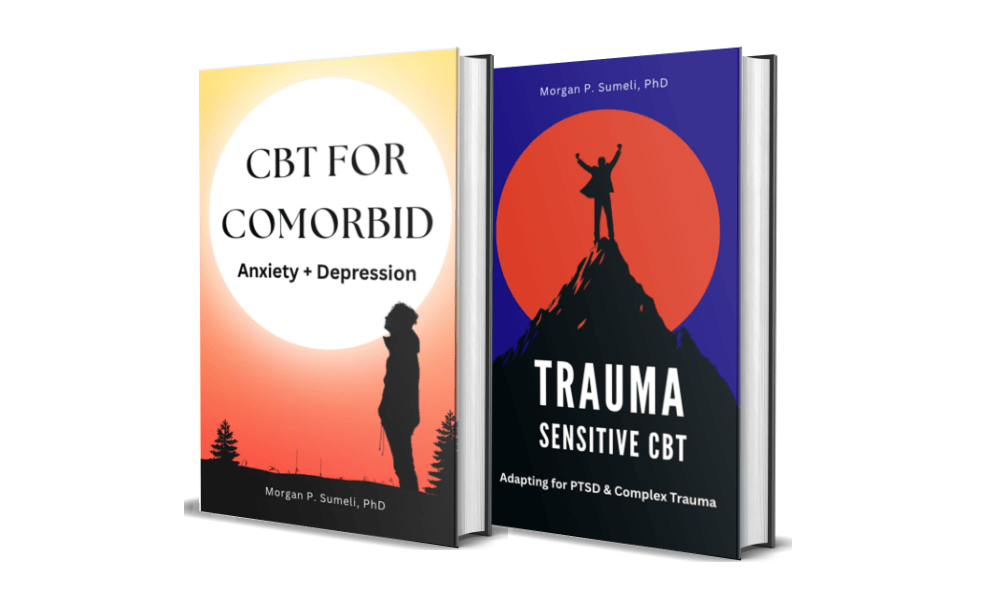
Book 1 – CBT for Comorbid Anxiety & Depression
What Other Therapists Miss: Breaking the Cycle
Most clinicians treat anxiety and depression as separate problems. They target one symptom, and the other flares up. The client feels misunderstood. Progress stalls.
This volume gives you the integrated protocol that elite clinicians use to treat both simultaneously. You’ll learn to address rumination, hypervigilance, and avoidance as interconnected symptoms—restoring momentum and preventing the dropout that frustrates so many practitioners.
Book 2 – Trauma-Sensitive CBT
The Skill Most Therapists Lack: Safety Before Processing
Here’s what separates competent trauma work from harmful work: knowing exactly when to stop cognitive restructuring. Most therapists push too hard, too fast, and inadvertently re-traumatize dysregulated clients.
This volume teaches you the advanced adaptations that prevent this critical error. You’ll learn to recognize dissociation, emotional dysregulation, and hyperarousal—and shift to nervous system regulation before processing. This is the difference between therapists who heal trauma and those who accidentally worsen it.
Why This Bundle Separates You from the Rest
While other therapists struggle with complex cases, you’ll have:
- The Dual-Track Assessment Matrix: See what others miss—which symptom is driving the cycle.
- Session-by-Session Treatment Plans: Flexible protocols that adapt to comorbid presentations.
- The “Safety-Before-Processing” Checklist: Avoid the critical error that harms clients.
- Clinical Scripts: Exact phrasing for navigating resistance—because most therapists lose clients here.
- Client Handouts & Homework: Professional tools that demonstrate your expertise.
For the Clinician Who Refuses to Settle
This isn’t for therapists who want basic CBT refreshers. This is for the clinician who handles the cases others refer out. The one who succeeds where colleagues struggle.
30-Day Money-Back Guarantee: If these protocols don’t elevate your practice above the standard, email us for a full refund. No questions asked.


L. Hernandez, LCSW (store manager) –
Practical, compassionate, and trauma-informed.
This isn’t just another CBT manual — it’s a clinician’s toolbox. The worksheets, case studies, and treatment planning tips are pure gold.
Nancy S., PMHNP-BC –
Bridges the gap between textbook and therapy room.
The trauma-sensitive adaptations of CBT are exactly what I needed to feel more confident working with clients who’ve experienced complex trauma.
Marc G., MA, Clinical Psychologist –
A must-have for CBT therapists.
I’ve been using CBT for years, but this bundle took my skills to the next level — especially when working with clients who present with overlapping issues. It’s clinical and human at the same time.
Angelina De Rood –
Well-structured, easy to apply.
Each chapter builds logically and gives practical, usable tools — especially around session planning, goal setting, and feedback integration.
Raymond L., LMHC –
I use this in every intake with complex clients.
The trauma-informed assessment chapter helped me rethink how I approach early sessions. It’s already improved how I build trust and safety.
Dr. Aisha Moore, PsyD –
Finally, a CBT guide that reflects real clinical complexity.
As a licensed therapist, I often work with clients who don’t fit neatly into one diagnosis. This bundle helped me navigate comorbid anxiety and trauma with clarity and structure. Highly recommended for any clinician who wants more than theory
James B., MFT –
Perfect for busy professionals.
The layout is clean, the strategies are focused, and it’s written by someone who clearly understands clinical demands. I reference this in almost every supervision session
Sophia D., DNP, Clinical Nurse Specialist –
Worth every penny.
This CBT bundle saved me hours of research and made me feel more prepared for my most challenging cases. It’s like supervision in book form.
Dr. Elena L. –
Most of my clients present with both anxiety and depression—not neatly separated, but intertwined. This book finally offers a practical, integrated CBT approach that meets them where they are. The assessment tools alone have improved my case conceptualization.
James W, LMFT (store manager) –
I’ve used traditional CBT for years, but this guide helped me see comorbidity not as a complication, but as a pattern to be understood. The session-by-session strategies are easy to implement and make a real difference in treatment pacing and engagement.
Dr. Naomi C, Counseling Psychologist (store manager) –
I wish I had this during my training. It demystifies the overlap between anxiety and depression and provides clear guidance on when to target which symptom cluster. My only note: would love a companion worksheet pack.
Andre T, LCSW (store manager) –
The transdiagnostic framework in this book has made my therapy more efficient and client-centered. I especially appreciate the focus on motivational fluctuations—something we rarely talk about but see every day.
Dr. Priya K, Clinical Director (store manager) –
So many manuals are either too technical or too vague. This one strikes the perfect balance: rigorous, practical, and deeply respectful of the client’s experience. Now a required text in our clinic’s training program.
Dr. Rebecca F, PhD, Trauma Specialist (store manager) –
This is the CBT resource I’ve been waiting for—one that honors neurobiology, attachment, and safety without sacrificing structure. It’s helped me adapt my practice to reduce retraumatization risks while still delivering effective interventions.
Marcus B, LICSW (store manager) –
Too often, CBT feels too fast for trauma survivors. This book changes that. The pacing guidelines, window-of-tolerance integration, and emphasis on relational safety have made my sessions more effective and humane.
Dr. Lila N, Clinical Psychologist (store manager) –
Working with clients who have complex trauma requires more than symptom checklists. This guide offers real tools—grounding adaptations, titration strategies, and trust-building exercises—that fit seamlessly into a CBT framework.
Carmen R, LMHC (store manager) –
I’ve read countless trauma books—some too abstract, others too rigid. This one is different. It’s grounded in science but written by someone who clearly understands the therapy room. Already recommended it to my entire team.
James W, LMFT (store manager) –
This isn’t just a manual—it’s a mindset shift. The trauma-sensitive lens transforms CBT from a technique-driven model into a truly collaborative healing process. A must-read for every clinician working with trauma.