
Description
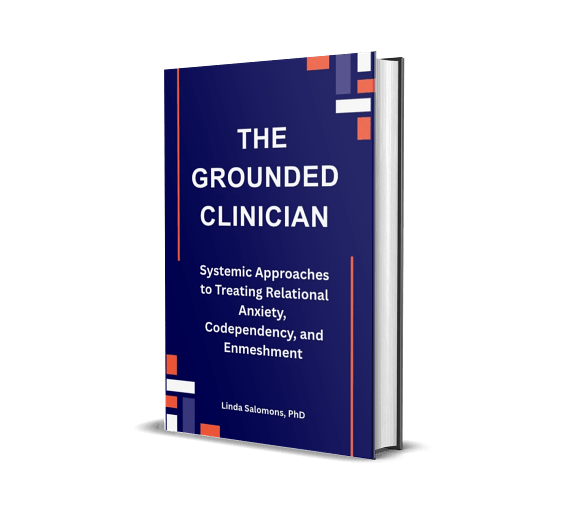
THE GROUNDED CLINICIAN
Systemic Approaches to Treating Relational Anxiety, Codependency, and Enmeshment
The Grounded Clinician: A Systemic Therapy Guide for Codependency, Relational Anxiety, and Enmeshment
For marriage and family therapists, counselors, and systemic practitioners, few challenges are as persistent—or as misunderstood—as codependency, relational anxiety, and enmeshment. Traditional models often treat these as individual pathologies or remnants of addiction-based frameworks. But in reality, they are relational patterns, maintained by entire systems desperate to preserve connection at the cost of differentiation.
The Grounded Clinician is a 98-page digital guide designed for therapists who know that effective systemic therapy begins not with technique, but with presence.
Written by Linda Salomons, PhD, this clinically rich resource moves beyond theory to offer actionable strategies for working with high-anxiety couples and families—while protecting your own emotional equilibrium.


James T., LPC, Certified Gottman Therapist (Texas) (store manager) –
As someone trained in evidence-based models, I appreciated how this book integrates Bowen without jargon. The chapter on relational anxiety reframed my entire approach. Short, potent, and deeply practical.
Maya C., MS, MFT Associate (New York) (store manager) –
Wish I’d had this during grad school. It names the subtle ways we get pulled into clients’ systems—and how to gently step back without disengaging. The section on non-anxious presence alone is worth the price.
Aisha N., Systemic Family Therapist (Canada) (store manager) –
No fluff, no platitudes—just grounded wisdom. The way Linda distinguishes codependency from care helped me stop pathologizing my clients’ love. Already dog-eared my PDF
Thomas L., Private Practice (Germany) (store manager) –
As a non-native English speaker, I appreciated the clean, direct sentences. Complex ideas made accessible. I’ve translated key passages for my supervision group—they’re equally impressed.
Dr. Kenji M, PhD, Adjunct Faculty (Japan/US) (store manager) –
This book embodies what systemic therapy should be: humble, observant, and human. Linda doesn’t tell you what to do—she helps you see clearly. Essential reading.
Dr. Robert H, Clinical Supervisor (UK) (store manager) –
I’ve recommended this to every therapist I supervise. It’s rare to find a resource that balances clinical depth with such clarity. Perfect for both new clinicians and seasoned practitioners needing a reset.
Leila F., Trauma-Informed MFT (Orego (store manager) –
So many resources ignore the therapist’s nervous system. This one centers it. I’ve reduced my post-session fatigue by using the transition rituals. Thank you for naming what we carry.
Markus V., Clinical Director (Sweden) (store manager) –
We’ve added this to our onboarding for new hires. At 98 pages, it’s concise enough to read in one sitting—but rich enough to return to. A rare balance.
Dr. Marilena G., LMFT (store manager) –
Finally—a systemic guide that doesn’t drown in theory. Linda cuts through the noise and gives us usable ways to stay grounded while working with enmeshed families. I’ve already used the ‘differentiation moments’ technique with two couples. Game-changer.
Sophie D., Couples Counselor (Australia) (store manager) –
The pursue–distance chapter gave me language I’d been missing for years. My clients now understand their cycle isn’t ‘broken’—it’s a survival pattern. That shift alone has deepened our work.